The price of freedom has never been higher—and by freedom, we mean a day pass at one of the large corporate resorts. As the price of a single lift ticket eclipses the cost of a decent snowboard, the core question becomes: How do we get cheap turns without sacrificing the powder and the vibe?
The answer is simple: Stop playing their game.
This guide is your roadmap to side-slipping the corporate behemoths, ditching the line, and finding legitimate, affordable ways to get on the mountain this winter.
Resort Riding: The Least Expensive Lift Tickets
You don’t need the mega-pass to ride lift-served terrain. You just need to look past the marquee names and find the local gems and community hills. These resorts are the soul of local riding, often run by families, towns, or independent operators, and they offer ticket prices that feel like a time machine to 2005.
Here are 5-7 categories of where you can consistently find the cheapest day tickets:
Town Hills & Night Riding: Think places like Howelsen Hill (CO), Bogus Basin (ID), or Sundance (UT). They often offer dedicated night passes for a fraction of the cost, usually utilizing limited lifts but serving up reliable features and low crowds.
The Midwest Gems: Resorts in the Upper Midwest (Lutsen Mountains, WI; Boyne Mountain, MI) often have competitive pricing and package deals, capitalizing on local rider loyalty rather than destination tourism.
The Pacific Northwest Independents: Outside of the I-90 corridor, mountains in Washington and Oregon (like Mission Ridge or Hoodoo) often have tickets that hover around the $60-$80 mark on non-holiday weekdays.
Community-Owned Co-ops: Look for mountains that are literally owned by the local community or a non-profit. These are rare but offer the best deals and strongest local culture.
Small East Coast/New England Spots: Ski areas in Vermont, New Hampshire, and New York like Plattekill (NY) or Magic Mountain (VT) lean into their old-school vibe with ticket prices that reflect their smaller size and no-frills experience.
The Indy Pass Solution
The Indy Pass is the anti-Epic/anti-Ikon. It’s a coalition of over 120 independent, community-focused resorts across the U.S. and Canada.
The Benefit: You get two days at every participating resort. This encourages exploration and supports local businesses, moving your dollars away from the infamous corporate entities.
The Cost: The Indy Base Pass is typically priced around the cost of two days at a major resort—making it the cheapest way to guarantee 100+ days of riding without selling your soul. It’s the closest thing we have to a genuine counter-culture pass system.
Learn to Splitboard: Earning Your Turns (and Silence)
If your goal is freshies, untracked, serenity, and freedom from the lift, you need to transition to splitboarding.
How to Get Started (The Essentials):
The Board: A dedicated splitboard, which includes the necessary hardware (hooks, clips, touring bindings) that allow the board to transition.
Skins: Nylon or Mohair strips that adhere to the base of the board halves. Their texture allows you to slide forward but grips the snow when pushed backward, enabling you to “walk” uphill.
Boots & Bindings: While any soft boot works, a dedicated touring boot with a walk mode and stiff bindings are recommended for comfort and efficiency.
The Pack: A dedicated backcountry pack (30-45L) to carry your board when booting, food, water, and crucially, your safety gear.
Safety Gear (Non-Negotiable): This equipment is not optional—it’s required to enter the backcountry. You must take an Avalanche Safety Course (AIARE 1 or equivalent) before using it.
Transceiver (Beacon): A small device that transmits and receives a radio signal to locate buried victims.
Probe: A foldable pole used to pinpoint a buried victim once the transceiver gets close.
Shovel: A compact, strong shovel for digging out a companion.
The Comparative Expense:
The upfront cost (board, bindings, skins, safety gear) is high—easily $2,000+. However, once purchased, the turns are free forever. If you ride 20 days a year, splitboarding pays for itself quickly compared to $200+ day passes.
Your First Step to Safety (Know Before You Go)
Before spending a dime on a splitboard or snowmobile, your actual first piece of gear is knowledge. The Know Before You Go (KBYG) program, spearheaded by the Utah Avalanche Center and adopted nationwide, is a free, essential primer for anyone interested in the backcountry.
KBYG covers the five key messages—Get the Gear, Get the Training, Get the Forecast, Get the Picture, and Get Out of Harms Way—in a fun, engaging, and non-intimidating way. It should be the absolute starting point for your education before you even consider entering uncontrolled terrain. Seek out a free presentation in your area!
Pat Moore’s Risk Maturity
For those looking to move past the introductory phase, professional snowboarder Pat Moore developed the Risk Maturity online course. This program, built with input from avalanche professionals, focuses on the psychological and decision-making aspects of backcountry travel. It’s a powerful tool for advancing your understanding of human factors (the ‘why’ we make mistakes) in avalanche terrain, which is often cited as the root cause of accidents.
Buy a Snowmobile: The Ultimate Powder Hack
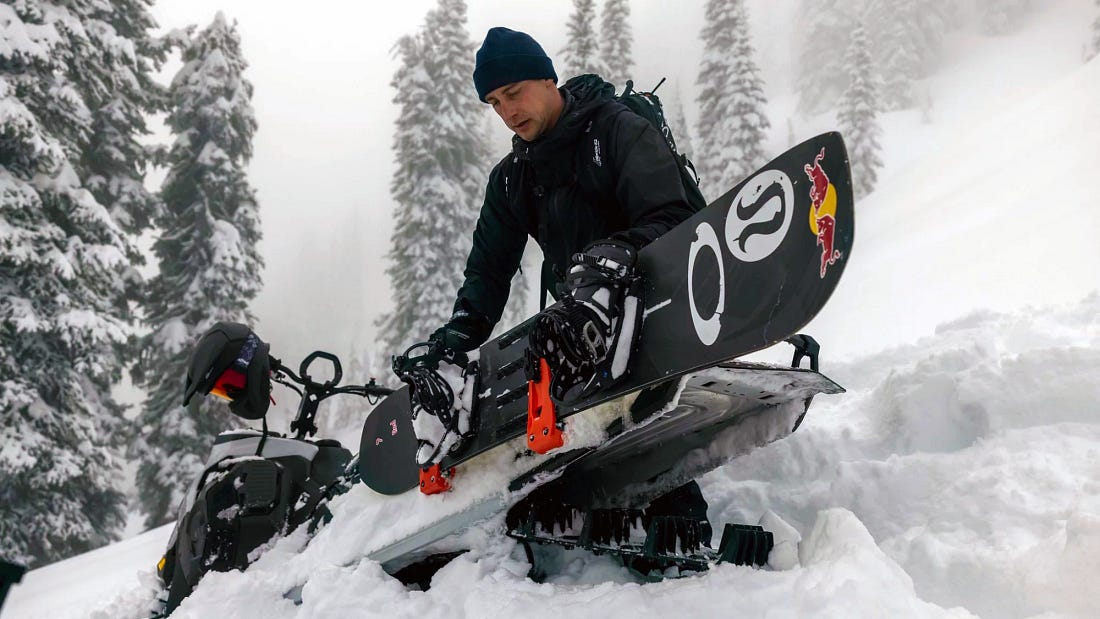
If splitboarding is slow and meditative, sledding is fast and full send—it’s the ultimate high-speed powder access tool. It drastically opens up National Forest access, providing endless, untouched terrain far beyond any lift-served boundary.
The Benefits (Why it Beats a Pass):
Fresh Powder, Zero Lines: You’re your own lift, accessing zones only limited by your navigational skill and gas tank.
Extended Season: You can find snow much earlier and later in the year at higher elevations than most resorts can maintain operations.
The Comparative Expense: A reliable used sled can be found for $5,000–$8,000, roughly 5–10 years of passes. Yes, there are gas and maintenance costs, but the sheer volume and quality of untracked snow you access fundamentally change the riding experience.
What You Need (The Must-Haves):
Sled: A dedicated mountain sled (long track, high horsepower).
Trailer: For transpo
Navigation: GPS and offline maps (like Gaia GPS).
Safety: ALL avalanche safety gear (transceiver, probe, shovel) is mandatory, as this terrain is uncontrolled. You should also carry a comprehensive repair kit and emergency supplies.
Get a Job at a Resort: The Work-for-Pass Trade
Sometimes, the best way to beat the system is to join the lower ranks. Resorts, even the corporate ones, desperately need staff and often offer a trade-off that is highly leveraged in your favor.
The Pass-for-Work Model: Many resorts, particularly smaller, independent ones, offer highly sought-after deals where you can work a single, scheduled 8-hour shift per week in exchange for a full, unrestricted season pass. Look for jobs like parking attendant, ticket scanner, or janitorial shifts.
The Paycheck + Pass Model: If you need a paycheck, almost every full-time or part-time job comes with a free pass. This is often the cheapest way to access those high-price resorts—you might be making minimum wage, but your pass is covered.
Where to Look: Focus on Lift Operations, and Food & Beverage (F&B) positions. These departments often have the highest turnover and need coverage the most.
Now get creative, look beyond the corporate con game, and go find your lines.









Tidak ada komentar:
Posting Komentar